The shared ledger path
- Fact
- Consensus
- Shared ledger
- Verification
Trust is established through agreement on replicated state under a shared consensus protocol.
Most enterprises don't need tokens or decentralized consensus. They need proof — that a product is authentic, a document untampered, a process executed deterministically and an outcome still verifiable years later. Nitrotick delivers that proof on the enterprise cloud stack you already run.
Already invested in a blockchain? Keep it — and add Nitrotick as its verifiable off-chain execution layer.
When companies evaluate blockchain, they are rarely after decentralization itself. They want four business guarantees. Nitrotick provides each of them directly.
The question a customer once asked us — “why integrate Nitrotick instead of building a blockchain platform?” — has a simple answer: sometimes the biggest innovation is not adding another layer, but removing the ones you never needed.
| Guarantee you need | How Nitrotick delivers it |
|---|---|
| Provenance | Every asset and state carries its lineage and the process that produced it |
| Integrity | Append-only, tamper-evident evidence and cryptographic commitments |
| Independent verification | Third parties verify proofs without access to your systems or raw data |
| Multi-party trust | Nitrotick Federation: bilateral trust between sovereign organizations |
Blockchain introduced a powerful idea: verifiable state through distributed consensus. But is global ledger replication the only path to independently verifiable outcomes? Nitrotick takes a fundamentally different architectural direction.
Trust is established through agreement on replicated state under a shared consensus protocol.
Trust is established through explicit authority, governed execution and cryptographically verifiable evidence.
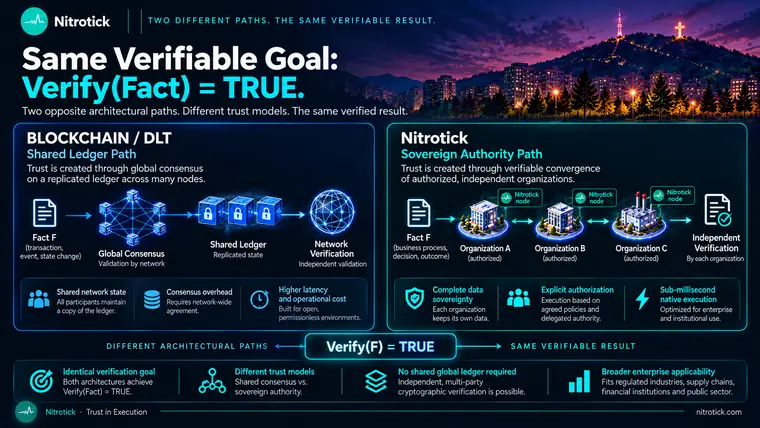
Blockchain coordinates agreement over shared state. Nitrotick coordinates verifiable execution across independent trust domains. The mechanisms and security assumptions differ — the objective of independently checking a claimed fact is shared.
Both approaches produce tamper-evident history. They differ in cost, speed, privacy and how much new technology your organization has to adopt.
| Dimension | Public / consortium blockchain | Nitrotick |
|---|---|---|
| Trust model | Network-wide consensus between nodes | Deterministic execution, cryptographic proof, bilateral federation |
| Where data lives | Replicated to every node; often public | In your own systems; only proofs and signals are shared |
| GDPR & erasure | Immutable ledgers collide with the right to be forgotten | Personal data stays erasable at source; proofs contain no PII |
| Latency | Seconds to minutes per confirmation | Under 100 ms per state transition |
| Running cost | Node hosting, gas spikes, percentage-based fees | Flat, predictable cloud or SaaS cost; zero gas |
| Initial build | Nodes, synchronization and smart-contract engineering | Runs on the cloud stack you already operate |
| Change & upgrades | Smart-contract audits on every major update | Governed backend logic with versioned policies |
| Revoking a participant | Contract changes or key rotation | Atomic revocation; healthy peers unaffected |
| Engineering talent | Scarce Solidity / Rust specialists | Standard enterprise (.NET) engineers |
Typical characteristics of each approach; actual effort depends on scope and deployment model.
Stablecoins solved simple token transfer. But moving money on-chain does not synchronize business state: personal data, business logic and authority still live in fragmented off-chain systems.
Nitrotick does not compete with money. It verifies, secures and governs the business process before settlement — and then hands the closed state transition to whichever rail you use.
We recommend a public blockchain when your use case genuinely needs one — and Nitrotick can work alongside it.
You don't have to choose. A blockchain is an excellent public tape, but it cannot run complex, private, governed processes. Nitrotick does that work off-chain and hands the chain a proven result.
No. Nitrotick has no ledger replicated between nodes, no consensus protocol, no tokens and no smart contracts. It provides provenance, integrity and independent verification through deterministic execution, tamper-evident evidence and cryptographic commitments.
Every step, approval and state transition is committed to append-only, tamper-evident evidence with cryptographic commitments. Any later change is detectable, and the history can be deterministically reconstructed and independently verified.
Yes. Proofs can be verified independently without access to your internal systems or raw data. For regulated and legally sensitive use cases, Nitrotick Qualified Anchor adds an external qualified trust anchor.
Yes. Nitrotick verifies and closes the business state transition first; settlement then runs over the rail you choose — regulated stablecoins, CBDCs or traditional banking rails such as SWIFT and SEPA.
Personal data stays in your systems of record and remains erasable there. Nitrotick federates signals, claims and proofs that contain no personal data, avoiding the conflict between immutable public ledgers and the right to erasure.
Yes. With Nitrotick Verifiable Off-Chain Execution & Oracle, complex and confidential workflows run off-chain under multi-party governance, and only a cryptographic commitment to the proven result is anchored on your blockchain or DLT network. Each network is connected through a dedicated adapter built for its finality and event model.
Describe your industry, your systems and the process you need to make provable. Message the founder on LinkedIn for a technical presentation or a tailored offer.